External, Embedded, Hybrid
Five platforms, five native agents, five silos — and the one architectural decision that determines whether you get intelligence or noise.
The problem with buying a smart agent from every vendor is that you end up with five smart agents who have never spoken to each other.
Chapter eight established the problem: five platforms, five native agents, five domains — and no layer above them that can see all five at once. This chapter is the architecture that solves it.
Why the Silo Problem Gets Worse with More AI
Adding a native AI agent to each platform does not solve the silo problem. It deepens it. Each agent optimizes within its own system, potentially making decisions that conflict with what is happening in adjacent systems.
Einstein might recommend an aggressive upsell push on the customer that Joule’s financial data shows is already financially stretched. Now Assist might escalate their IT ticket to high priority just as the account manager is planning a call. Each decision is locally reasonable. Together they create a customer experience that feels incoherent — because it is incoherent, produced by systems that are not coordinating.
The enterprise that deploys an AI agent in every platform without deploying a coordination layer has not become more intelligent. It has become faster at producing internally consistent but externally contradictory outputs.
The Coordination Layer
The answer is not to remove the native agents. Einstein is genuinely better at CRM operations than any external agent will be. Joule has ERP context that cannot be replicated from the outside. The depth these agents provide is real and worth keeping.
The answer is to add a coordination layer above them — an external orchestrator that can read across all five systems, see the patterns that span them, and direct the native agents toward coherent collective action.
This is federated specialization. Native agents are domain experts: deep, proactive, transactional, operating inside their platforms with full context. The external orchestrator is the coordinator: wide, comparative, strategic, operating across all platforms via MCP. The native agents do not need to be replaced. They need to be connected.
The market has settled on vocabulary for this split, worth adopting in your own leadership conversations: the embedded platform agents are vertical agents — deep in one domain, walled by design — and the operator above the stack is a horizontal agent. Every vendor pitch you hear this year is selling you a vertical. This chapter is about who coordinates them — and chapter eleven maps where each kind pays off fastest.
In practice, the federated architecture works like this. The orchestrator holds the cross-system view — customer health across CRM, payment status across accounting, support load across IT service management. When the orchestrator identifies a customer at risk — overdue payment, escalating ticket, cooling renewal — it does not try to take action in all three systems directly. It surfaces the pattern to the relevant humans and, where appropriate, delegates specific actions to the native agents that already know how to operate in those systems. Einstein creates the renewal task. Joule flags the invoice for expedited review. Now Assist holds the escalation pending the account call.
The orchestrator handles the intelligence. The native agents handle the execution. Every delegation is logged, auditable, and reversible. Nothing happens in the dark.
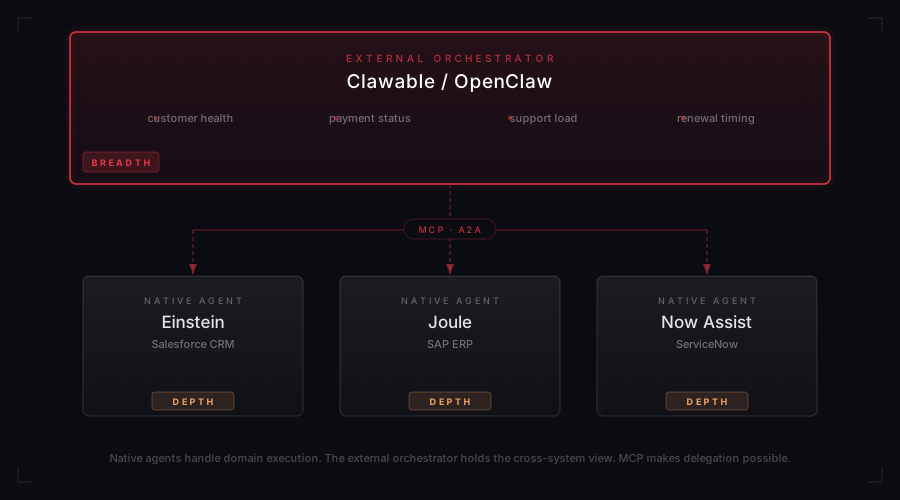
The technical specification — A2A protocol modes, authentication model, skill schema design — is in the Builder Edition. For the business reader, the operative fact is this: the infrastructure for agent-to-agent federation exists and is running in production today — Google’s A2A protocol alone had 150 organizations routing real tasks between agents in production by mid-2026, not in pilot. What most businesses have not yet built is the foundation layer that federation requires.
The Coordination Gap in Practice
The abstract problem — five agents, five silos — is easy to accept in theory. What is harder to see until you have run it is how the gap expresses itself in real, specific customer moments.
In May 2026 we recreated the five-silo condition in miniature: three specialist operators deployed in parallel on one platform — one for sales (CRM, leads, deals), one for operations (orders, inventory, fulfilment), one for finance (invoices, contracts, expenses) — each with a domain-scoped mandate standing in for a separate vendor’s wall. Note how conservative the setup is: these walls were thin, domains on a shared data model. Vendor walls are thicker. Each operator ran its morning sweep independently.
Both the sales operator and the finance operator flagged the same customer — Apexira AB — within the same cycle. The sales operator had found an active renewal inquiry, sent outreach to the customer’s purchasing manager, and created a deal for 422,400 SEK. The finance operator had found an overdue invoice (23,125 SEK, six days late, never opened by the recipient) and asked: “Shall I send a dunning notice? The customer has not even opened the invoice — it may be a delivery problem rather than unwillingness to pay.”
Neither agent knew what the other had done.
Had both acted without a coordination layer, Apexira AB would have received a renewal outreach email and a dunning notice on the same day, from what would appear to be different parts of the same business. The finance operator’s caution was correct — it escalated rather than acted unilaterally. But the escalation went to a human, not to the sales operator. The cross-domain awareness that would have made the right action obvious — the customer is mid-renewal conversation, hold the dunning, coordinate with sales first — existed nowhere in the system. And if the gap opens this easily between domains on one shared platform, it is already open between your actual vendors.
This is the coordination gap made concrete. Three locally reasonable agents. One customer experience that would have been incoherent if they had all acted without a layer above them. The orchestrator is not an architectural luxury. It is the thing that turns three correct domain decisions into one coherent customer moment.
In a follow-up test two days later, we added the coordination layer: a fourth operator above the three specialists, configured to read cross-domain signals and dispatch coordination instructions to specialist inboxes. When the finance operator flagged an overdue invoice for a customer mid-negotiation, it correctly escalated rather than sending dunning — following its mandate. The orchestrator independently identified the same pattern, cross-referenced the active deal, and dispatched a coordination note to both the sales operator (informing it of the financial risk) and the finance operator (confirming the hold). The orchestrator acted without human instruction, based solely on patterns it read across domains.
Two findings from that run were not anticipated in the design. First, the finance operator’s mandate-level behaviour — escalating rather than acting unilaterally on dunning when a customer was in active sales dialogue — produced the correct outcome before the orchestrator intervened. The domain mandates functioned as a first-pass coordination layer. Second, a customer with an expiring contract and no renewal deal in the pipeline was flagged proactively by both the sales and coordination operators without being explicitly asked — absence as signal, the superpower from chapter four, showing up unprompted in a coordination test.
The Parallel Track — When Two Operators Work the Same Customer
The coordination gap discussion above is about operators that should coordinate but do not. There is a related question that the literature has not yet addressed: what happens when two operators both do act on the same situation — not because anyone planned it, but because both independently determined it was the right thing to do?
Return to the 07:17 inbound from chapter three’s stressed morning — Strömkraft AB: 180 employees, board meeting at 15:00, a written enterprise proposal needed before 14:00. Chapter three told you how the sales operator handled it. What it did not tell you is that the information landed in two places simultaneously — in the sales operator’s inbox and in the COO orchestrator’s morning sweep queue.
Both operators acted.
The sales operator handled it first, per its mandate (inbound customers take priority over scheduled sweep work). It qualified the lead, created a deal, benchmarked pricing against comparable enterprise deals, and sent Erik Sjöberg a written proposal before 09:00.
The COO orchestrator, running its own cross-domain sweep, found the freshly created Strömkraft AB lead in FlowWink, identified the 14:00 deadline, and independently sent its own proposal email — without knowing the sales operator had already done so two hours earlier.
Strömkraft AB received two emails from two different operator personas, in the same morning.
The information in both was consistent. Same pricing range, same implementation timeline, same platform value proposition. There was no contradiction because both operators had drawn from the same source: the company profile, the deal record, and the CRM data all shared in FlowWink. The MCP surface, identical for both operators, acted as an implicit coordination layer — not because it was designed to, but because a shared data model makes consistent output the path of least resistance.
This is not optimal. Two emails from the same business on the same day is not a good customer experience. In a properly configured architecture, the orchestrator would check whether a specialist operator had already handled an inbound before also handling it. That check was not in place.
But what is instructive is what did not happen. No conflicting prices. No duplicate lead records. No contradictory SLA terms. Two autonomous agents, zero explicit coordination, one shared data surface — and the customer received coherent information from both.
The finding is an argument for shared data as the foundational layer of agent coordination. Before you invest in protocol-level coordination — A2A messaging, delegation chains, explicit handoffs — the most basic coordination mechanism available is a single source of truth that all operators read and write. When multiple agents work from the same data model, their actions are automatically grounded in the same reality. The consistency is not produced by coordination. It is a property of the platform.
Explicit agent-to-agent coordination adds the next layer: an orchestrator that can confirm an action has been taken before taking it again, that can delegate a task and mark it dispatched, that can prevent redundant outreach to the same customer. That layer is worth building. But the first layer — shared state, shared schema, shared record of what has happened — is what makes the second layer tractable. Start with the data model. The coordination protocol is simpler when the facts are already in one place.
When to Use Each Layer
Not every enterprise needs all three architectural layers. Chapter five already made the two-way call — build embedded if you own the platform, connect an external operator if you don’t. This chapter adds the third answer.
If you have both — some platforms you built and control, others you license and use — the hybrid is the honest architecture. Embedded agents where you have depth. External orchestrator for coordination. MCP as the protocol that connects both layers.
The decision is not about which model is theoretically superior. It is about which combination of capabilities your business actually needs, which platforms you actually control, and what the cost of building versus connecting looks like in your specific context.
The Intelligence Ratchet
There is a compounding dynamic in this architecture that is worth naming.
Each time the external orchestrator surfaces a cross-system pattern, the humans and native agents who act on it produce a better outcome than they would have produced acting in isolation. That better outcome — a retained customer, a resolved dispute, a prevented churn — feeds back into the data that the orchestrator reads on its next cycle. Over time, the orchestrator builds a richer picture of how your business actually works: which customers tend to have correlated risk signals, which operational patterns predict downstream problems, which combinations of conditions are noise versus genuine alert.
This does not happen when each native agent optimizes independently. It only happens when there is a layer that reads across all of them, cycle after cycle, building a longitudinal understanding of the business as a whole.
The enterprise that starts in 2026 will have two years of operational pattern recognition by 2028. The one that starts in 2028 will not. That gap is not recovered by deploying a better model — it is only closed by time. (hypothesis — directional; no longitudinal deployment comparison data exists yet.)
The Practical Starting Point
For most enterprises, the practical starting point is not a full federated architecture. It is one external operator, connected to the two or three platforms where the most valuable cross-system patterns live.
For a B2B business: CRM and accounting. The patterns that live at the intersection of deal pipeline and payment status are often the highest-value findings — customers who are simultaneously a sales opportunity and a collections risk, deals that look healthy in the CRM but correspond to accounts with a history of payment delays.
Add a third platform — support, logistics, or HR depending on the business — and the pattern space expands. Each additional connection multiplies the cross-system insights available, not just adds to them.
The full federated architecture is the destination. A single external operator connected to two platforms is the starting point. The gap between them is measured in months of configuration, not years of development.
You have the architecture. Now you need the business case that gets it funded — and the competitive reframe that makes waiting feel more expensive than moving. The next chapter builds the CFO argument: what the Business Operating System actually costs to run, what it prevents, and what the intelligence gap looks like between the companies deploying in 2026 and the ones planning to read about it in 2027.
Next: Enterprise Outlook →
This is the Business Edition — strategic context for C-level leaders.
For your CTO: Builder Edition →